 Search


- The world’s most powerful tidal turbine outputs electricity to the grid, which is an important step in tepoising renewable energy sector
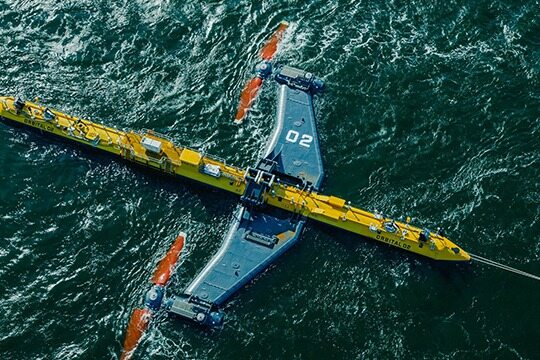
The O2 floating turbine developed by the Scottish engineering company Orbital Marine Power started generating electricity at the European Ocean Energy Centre in Orkney on the north coast of the Scottish mainland. This innovative device is anchored in the fall of Warness, and a submarine cable connects the 2MW offshore unit to the local onshore power grid.
O2 was manufactured and launched in Dundee in early 2021, and then towed to the Orkney Islands. It is the first commercial turbine of the Orbital Company after more than 15 years of product development. This 74 million-long turbine is expected to run for 15 years and can meet the annual power needs of approximately 2,000 households. Its clean, predictable power comes from the fast-moving waters of tidal currents. The equipment’s electricity will also power onshore electrolyzers to produce “green” hydrogen, demonstrating its ability to achieve more extensive decarbonization.
Andrew Scott, CEO of Orbital, said: "Our vision is that the project is a trigger to use global tidal current resources to play a role in combating climate change while creating a new low-carbon industrial sector." Floating turbines are designed to overcome The challenge of tidal power generation. The promising installation site, by its very nature, is located in water with very fast velocities. At a depth of 30-40m, the water speed may reach 16km/h, with only a few minutes of relaxation every day. The high density of water means a higher potential power relative to air, which is a challenge.
Attractive locations are often found on rugged headlands or rocky areas around remote islands and are often difficult to reach. This makes the maintenance of the stationary turbine difficult and very expensive. On the other hand, O2 is designed for relatively simple and cost-effective installation. Scott previously told Professional Engineering that it can also be maintained throughout its use.
Orbital's current goal is to commercialize its technology by deploying multi-megawatt arrays. The company said that in addition to contributing to the clean energy transition, installing in British waters can also bring huge benefits-about 80% of the turbines are provided by British suppliers, and the operation will bring long-term employment to coastal communities. As evidenced by wind and solar energy, as the technology is commercialized, the cost is expected to drop. Public lenders provided support for the construction through the "ethical investment platform" Abundance Investment and the support of the Scottish government.
The Scottish Government’s Net Zero Sum Energy Cabinet Secretary Michael Matheson said: With our wealth of natural resources, expertise and ambition, Scotland is in an ideal position to take advantage of the huge global marine energy market while helping to achieve a net zero economy. This is why the Scottish government has supported the marine energy sector for more than 10 years, including providing 3.4 million pounds for the project through the Saltire Tidal Energy Challenge Fund.
Keywords: new energy, foreign engineering news
"Orbital Marine Power's O2 is the most powerful tidal turbine in the world. Its deployment is a proud moment for Scotland and an important milestone for us to achieve net zero emissions." Editor/XuNing
Comment






 Praise
 Collect
 Comment

 Share
Share


Write something~