 Search


- Kong Xuanyouzhi expressed the hope that more Japanese people can enter the museum and learn about Chinese history and culture
With the joint efforts of China and Japan, the large-scale cultural relic exhibition "Terracotta Warriors and Horses and Ancient China - Legacy of Qin and Han Civilizations", which has been in preparation for three years, kicked off recently in Kyoto, Japan.
On the day of the first exhibition, an old Japanese man raised his head slightly to look at the warrior figurines of Qin armor. For a moment, time and space seem to travel back to more than 2,000 years ago, and the glorious civilization of ancient China's Qin and Han dynasties reappears before us.
Luxurious lineup
On March 25, 2022, the first exhibition of "Terracotta Warriors and Horses and Ancient China - Legacy of Qin and Han Civilizations" was held. There was an hour before the official opening on that day, and Japanese people had long queued outside the exhibition hall of the Kyocera Art Museum to wait for admission.
The exhibition displays a total of 121 cultural relics (groups) from 16 cultural institutions in Shaanxi Province and 1 in Hunan. Treasures of cultural relics, of which the first-class cultural relics account for 20%.
The exhibition is divided into three parts: "Qin on the Eve of Reunification", "The Birth of the Unified Dynasty" and "The Prosperity of the Han Dynasty", focusing on some notable characteristics of China's development from the Western Zhou Dynasty through the Spring and Autumn and Warring States Period to the Qin and Han Dynasties, as well as the development of China in recent years. The research results of Qin and Han history and culture represented by the Mausoleum of the First Emperor of Qin and the Yang Mausoleum of Emperor Jing of the Han Dynasty.
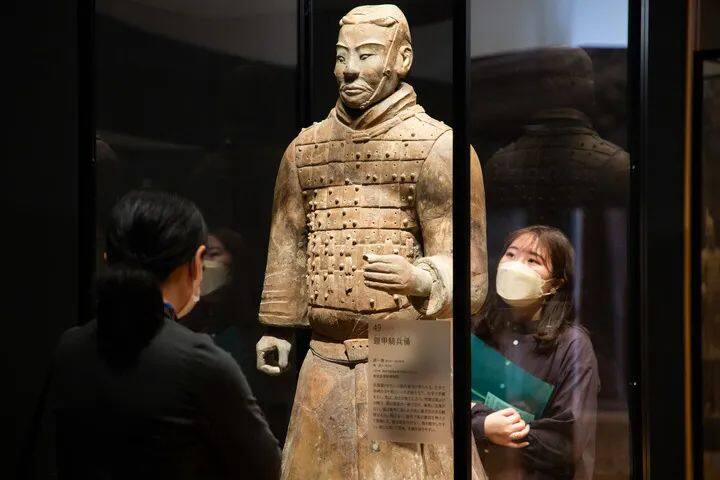
Visitors visit the exhibition "Terracotta Warriors and Ancient China - Legacy of Qin and Han Civilizations" held in Kyoto, Japan, on March 25, 2022
According to Mitsuhiko Mori, a research librarian at the Kyocera Museum of Art, the biggest highlight of this exhibition is that not only can you see the large terracotta warriors and horses of the Qin Dynasty, but also the small-sized terracotta warriors and horses of the Han Dynasty before the Qin Dynasty and after the Qin Dynasty. Through these precious cultural relics You can learn about the historical changes of the Terracotta Warriors.
Visitors to the Terracotta Warriors and Horses of Qin Shihuang, the small Terracotta Warriors and Horses of Xianyang Yangjiawan, the animal figurines unearthed in the burial pit of Emperor Jing of the Han Dynasty, the gilt bronze horses collected in the Maoling Museum, the Han portrait stones unearthed in Yulin area of northern Shaanxi, and the Qin bamboo slips in Liye, Hunan, etc. I stopped to appreciate the precious cultural relics showcase, and refused to move for a long time.
The 10 showcases in the last exhibition hall are the highlight of this exhibition - the warrior warriors in armor, the warriors in armor, the warriors standing up and the warriors sitting on the ground. Especially interesting. Visitors can not only enjoy a 360-degree close-up view, but also take photos with the Qin Terracotta Warriors and Horses.
good luck
In 1976, the first overseas exhibition of the Qin Terracotta Warriors was Japan. This year coincides with the 50th anniversary of the normalization of diplomatic relations between China and Japan. The Qin Terracotta Warriors and Horses "Revisit their Hometown" shoulders the mission. The exhibition "Terracotta Warriors and Horses and Ancient China - Legacy of Qin and Han Civilizations" has naturally become one of the important cultural exchange projects between China and Japan.
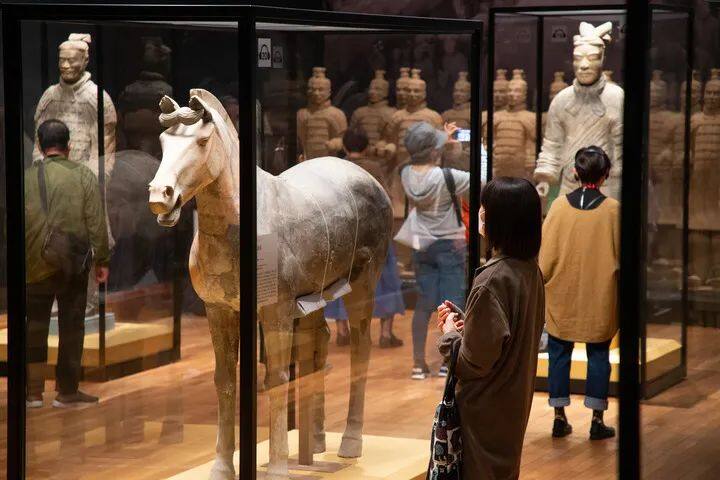
Visitors visit the exhibition "Terracotta Warriors and Ancient China - Legacy of Qin and Han Civilizations" held in Kyoto, Japan, on March 25, 2022
This exhibition is sponsored by the Shaanxi Provincial Bureau of Cultural Relics of China and the Japan Sino-Japanese Shimbun Tokyo Headquarters ("Tokyo Shimbun"), the Shaanxi History Museum (Shaanxi Provincial Cultural Relics Exchange Center), the Qin Shihuang Mausoleum Museum, and the exhibition venues in Kyoto, Shizuoka and Nagoya, Japan. , jointly organized by cultural and cultural institutions in Tokyo and a number of news organizations. After the Kyoto Station exhibition ends on May 22, it will also tour Shizuoka, Nagoya and Tokyo. The entire exhibition lasted for nearly a year.
This is also the first time the Qin Terracotta Warriors have been exhibited overseas since the outbreak of the new crown epidemic. In the summer of 2019, the Tokyo Shimbun officially approached the Shaanxi Provincial Bureau of Cultural Relics and reached a preliminary intention to hold the exhibition. However, the Covid-19 pandemic that swept the world shortly thereafter brought unimaginable difficulties to the exhibition.
The epidemic once blocked personnel exchanges between the two countries, and the Japanese side could only select the cultural relics for exhibition through photos. In addition, due to issues related to the safety of the first-class cultural relics of the Qin Terracotta Warriors and the assembly of bronze chariots and horses, the Chinese personnel could not hold the exhibition without visiting the exhibition site. Therefore, the Japanese side had to change the original plan, and the first exhibition will be held in Tokyo in December 2021. The release was changed to start in Kyoto in March 2022.
However, as the extension period approaches, regeneration waves are raging. In December 2021, Xi'an implemented strict epidemic control measures, and the Shaanxi Provincial Cultural Relics Exchange Center was forced to interrupt the secondment of cultural relics from various cultural and museum units. After the Spring Festival, the center dispatched 5 groups of people to quickly arrange all the exhibition cultural relics in just one week, and encountered heavy snow on the way. weather. The epidemic has caused the transport aircraft to be tight, and the last batch of cultural relics will not be shipped until March 18, 2022.
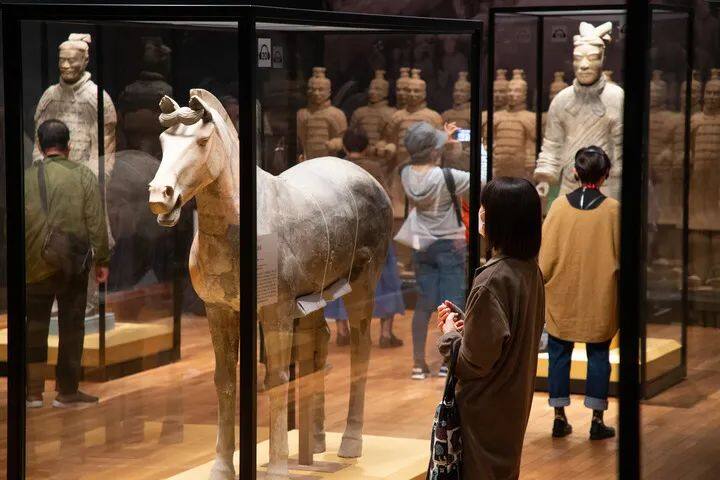
The exhibition staff of the Shaanxi Cultural Relics Exchange Center are assembling the bronze chariots and horses
high hopes
Both China and Japan have high hopes for this hard-won exhibition. Kong Xuanyou, Chinese Ambassador to Japan, sent a written congratulatory message, expressing the hope that more Japanese people can visit the museum to learn about Chinese history and culture. He believes that the exhibition will further promote mutual understanding between the people of China and Japan and deepen the friendship and cooperation between the two countries. The Japanese organizer said in a written speech that he sincerely hoped that this exhibition could become an opportunity to deepen friendship between Japan and China.
The consultant of this exhibition and honorary professor of Gakushuin University Kazuyuki Tsuruma told reporters that although Japan-China relations have fluctuated from time to time, the Japanese people are very interested in ancient Chinese culture and hope that this exhibition will further promote the stable and friendly development of Japan-China relations . He also said that he was very happy to see many young Japanese people coming to the exhibition and looked forward to the next generation to build a brand new Japan-China relationship.
Chinese cultural relics such as the Qin Terracotta Warriors and Horses are like a bridge for mutual learning between civilizations, allowing the world to better understand Chinese culture. Tang Qishan, curator of the exhibition and executive director of the Japan-China Cultural Association, has a deep understanding of this: "The exhibition of cultural relics brings pride to the Chinese and at the same time makes foreigners sincerely admire China. Surprise and can not help but admire, when you learn that many people like China and are interested in Chinese history through the exhibition, you will find that such an exhibition is the best and most practical cultural bond.”Editor/Ma Xue
Comment



 Praise
 Collect
 Comment

 Share
Share


Write something~