 Search


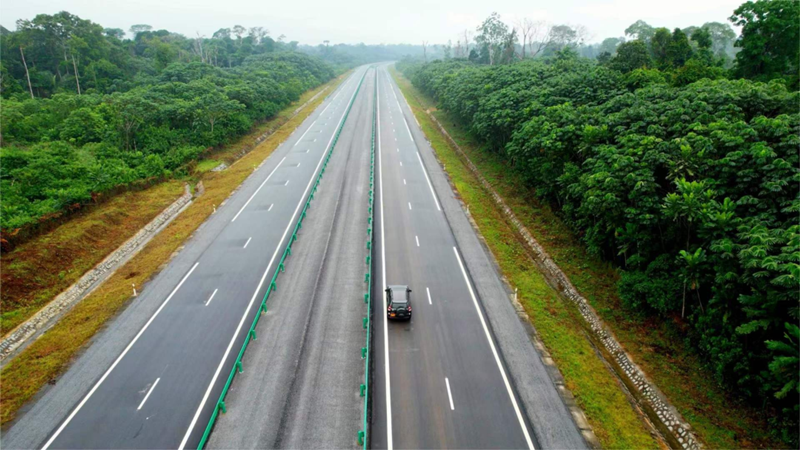
- The Cribbi to Rohrabe Highway main line is 38.5 km long
- Upon completion, traffic conditions will be further improved and local social and economic development will be further promoted

"Over the years, I have witnessed the development of the permanent road surface from scratch, and also felt the gratitude and admiration of the African people to China!" Yang Pengfei, assistant project manager of the Second Public Bureau, was full of pride at the opening ceremony of the highway from Keribi to Rohrabe in Cameroon.
Cribbi to Rohrabe Speedway
The 38.5 km-long Kribi to Rohrabe expressway, contracted by China Harbor and constructed by the Second Public Transportation Bureau, is the first highway in Cameroon to be built and operated using Chinese standards. The construction of the project will greatly improve Cameroon's national road transport capacity.
At the beginning of the project construction, the improvement of asphalt concrete has been put on the agenda. It turns out that the technical team in carding difficulty found, is located in central Africa, Cameroon its typical tropical rain forest climate with high temperature and rainy all year overall soft subgrade, if use the traditional asphalt concrete, pavement anti-rutting ability can not get effective protection and easy to crack, the serious influence of road surface quality at the same time, back to the late maintenance bring great pressure.
Through consulting a lot of information, a high modulus asphalt concrete into the technical team's vision. This kind of concrete has strong ductility and fatigue resistance, which is mainly used to solve the problems of the lack of rutting resistance of the surface layer and the lack of stiffness of the base layer under complex climate conditions, which just meets the needs of the project. However, the high modulus asphalt concrete was originally used in France, and the huge environmental differences made it impossible to apply it directly to Cameroon, so the project department had to make adjustments according to the actual situation.
The strength of asphalt pavement mainly depends on the strength of asphalt concrete, and improving the quality of stone material required for concrete has become the primary task of the technical team. Gneiss is the stone material used in most parts of Cameroon, and the aggregate used for the pavement is rolled from gneiss. However, because gneiss contains quartz and mica that do not adhere well to asphalt, the performance of mixed asphalt concrete is compromised. To solve this problem, the project team efficiently and quickly screened out rocks with high quartz and mica content by observing color at the outages and testing bedrock core samples, ensuring that the technical specifications of gneiss meet the concrete requirements to the greatest extent possible. In addition, the technical team also added alkaline filler, anti-peeling agent and other substances in the process of mixing asphalt mixture, which effectively improved the adhesion between aggregate and asphalt. After many twists and turns, "Camelon Special Edition" high modulus asphalt concrete was successfully produced. According TO THE TEST, THE NEW HIGH MODULUS CONCRETE CAN NOT ONLY IMPROVE THE STRENGTH, but also change synchronously according to the deformation of the subgrade, and the pavement cracking will be greatly reduced.
To create "permanent pavement", it is not enough to have new high modulus concrete, and the construction process is also imperative to upgrade. According to statistics, new high modulus concrete paving thickness of at least 10 cm, if the traditional paving process, by paver weight limit, is bound to be divided into 2 to complete paving, rain infiltration will lead to poor adhesion between the two layers, pavement quality can not be guaranteed. To this end, the project technical team has developed the technology of one time paving of large-thickness asphalt pavement base, which can increase the weight of pavers, improve the rolling frequency of pavers, increase the adhesion degree of asphalt concrete, and greatly reduce the risks of asphalt pavement slurry, which not only reduces the equipment investment, but also ensures the flatness of the pavement.

Thanks to the use of high modulus asphalt concrete and a new paving process, the new road surface will require nearly 50% less maintenance and the service life of the Cribbi to Rohrabe Highway will be significantly improved over the conventional road surface. Now, the project team is working to extend the new technology to similar projects, aiming to create more Chinese-made "permanent roads" in central Africa. Editor/He Yuting
Comment







 Praise
 Collect
 Comment

 Share
Share


Write something~