 Search


- Will reduce transportation costs and meet the potential demand for freight services and economic activities in the region

According to news from the Chinese Embassy in the Philippines on the 16th, the Philippine Ministry of Transportation and Chinese companies signed a commercial contract for the Subic-Clark railway project on January 16, 2021. This is the largest Sino-Philippine intergovernmental cooperation project to date.
The Subic-Clark railway project is funded by China and costs approximately US$940 million. The Subic-Clark Railway is the flagship project of the Philippine government's "Build, Build, Build" infrastructure construction plan and an important part of the Philippine Luzon rail network plan. The project is located in the central part of Luzon Island, connecting the two major transportation hubs of the Subic Bay Freeport Zone and Clark International Airport, and connecting with the Philippine Northern Line Railway.
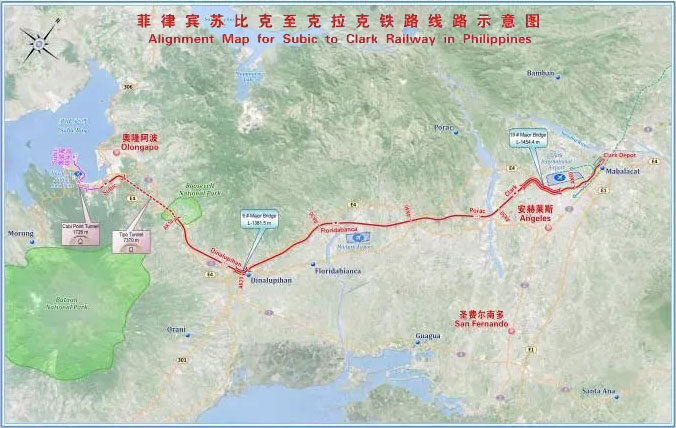
The Subic-Clark Railway is approximately 71 kilometers long, and the long-term plan will extend to Clark New Town. The project mainly adopts Chinese standards and will be designed in accordance with the single-track standard gauge freight railway. The construction period is about 42 months. After the completion of the project, the port-rail-air multimodal transport in the core area of the Philippine economy will be realized, effectively improving the efficiency of logistics transportation, reducing logistics costs, and helping the regions along the route to release their economic development potential.
The Chinese Embassy in the Philippines stated that the Subic-Clark railway project is planned to be financed by China. In the next step, China and the Philippines will negotiate on the project loan agreement.
In 2017, under the leadership of President Rodrigo Duterte, the Philippine government launched the "Build, Build, Build" infrastructure plan, which plans to spend between US$160 billion and US$180 billion on public transportation. The construction project covers roads, bridges, airports, railways, ports, flood control facilities and other fields. Currently, many Chinese companies are participating in infrastructure construction projects in the Philippines.Editor/Huang Lijun
Comment


 Praise
 Collect
 Comment

 Share
Share


Write something~