 Search


- The Xiaohe Ancient Road starts at Xiaoshui and ends at Hejiang, with a total length of 187 kilometers

Between Mengzhuling and Yuechengling in Wuling, there is a long and narrow passage connecting Hunan Xiaoshui and Guangxi Hejiang, soldiers of the Qin Dynasty, military commanders of the Han Dynasty, court officials of the Tang and Song Dynasties, and caravans of the Ming and Qing Dynasties. They have all entered Lingnan. This land and water passage hidden in the mystery of two thousand years of history was called Xiaohe Ancient Road by later generations. It was the most convenient connection point between China's land Silk Road and the Maritime Silk Road in the early days.
From September 12 to 13, 2020, at the Fifth Cantonese Culture Forum held in Fengkai County, Zhaoqing City, more than 40 university professors and experts in literature and history conducted discussions and exchanges on the theme of "Xiaohe Ancient Road and Lingnan Civilization". The history of Xiaohe Ancient Road has once again attracted the attention of the world.
Xiaohe Ancient Road
The Xiaohe Ancient Road originated from the migration and communication of ancient humans, but it was actually developed and utilized on a large scale from the Qin Dynasty. In 219 BC, Emperor Qin Shihuang, who had destroyed the six nations, launched the war against Baiyue for the first time. The rugged mountain roads and long transportation lines led to inadequate supply of grain and grass. The Qin army was alone in Lingnan, and the first battle was unfavorable. Qin Shihuang quickly adjusted his strategy, "enable Jianlu to dig the canal to transport grain" and excavated the Xing'an Ling Canal, which connected the Yangtze River system and the Pearl River system. However, for hundreds of thousands of troops, the carrying capacity of a Ling Canal is limited, so the Qin Army continued to expand the Lingnan Ancient Road. From Xianyang, the capital of the Qin Dynasty, the new corridor along the Wulingqiao Road to Guangzhou became the "new road" in the Qin Dynasty.
The craftsmen built a road and bridges when they met water and built a water and land transportation hub between the high mountains and ridges of the Mengzhuling Mountains, connecting the Yangtze River and the Pearl River through the "new road". Among them, the east line of Xiaohe Ancient Road is developed on the basis of the pre-Qin ancient road, from Jianghua County, Hunan, crossing Guiling, entering the He River and then entering Linhe; the west line from Jianghua County, Hunan, crossing the small capital Pangling, entering Linshui, and passing through Fuchuan County Re-enter Linhe.
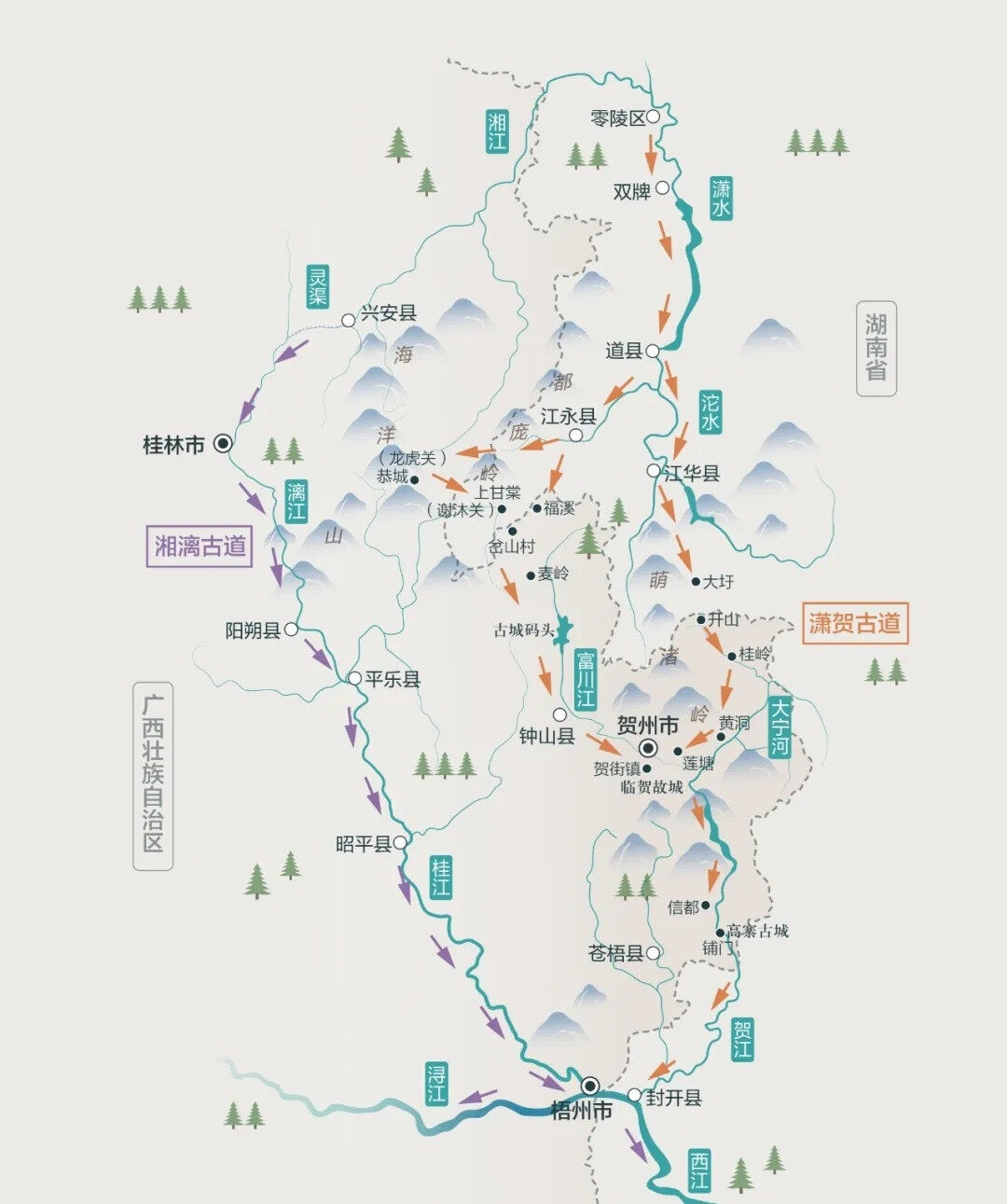
Through the newly built passage, the Qin Army's three-way army marched eastward. Among the two-way army that entered Guangxi and attacked Xiou, one entered Guilin via Yuechengling, and the other entered He County from Mengzhuling and passed Xiaohe. The ancient road enters South Vietnam. In 214 BC, the Qin Army suppressed Baiyue and unified Lingnan. The Xiaohe Ancient Road created a new era of transportation exchanges between Guangdong, Guangxi and Hunan. Since then, the flow of people, logistics, capital and information between the Central Plains and Lingnan has flowed unimpeded.
Overseas cultural and trade goods travel north through this road. From the Han Dynasty to the beginning of the Tang Dynasty, overseas goods entering the Pearl River Estuary to be transported to the capital had to travel through the Xijiang River to reach Hejiang, cross the Xiaohe Ancient Road to Dao County in Hunan, and then travel north along the Xiaoshui River, enter the Xiangjiang River, and then pass Dongting. Lake, enter the Yangtze River, and then go north to the Han River, you can reach the ancient capital of Xi'an.
The advanced culture and production technology of the Central Plains also continue to spread south through this channel. After passing through the Xiaohe Ancient Road, people and goods travel south along the He River, enter the Xijiang River, and then pass through the Pearl River system extending in all directions. They can reach many places in Guangdong and Guangxi, and they can go to the sea from Xuwen and Hepu.
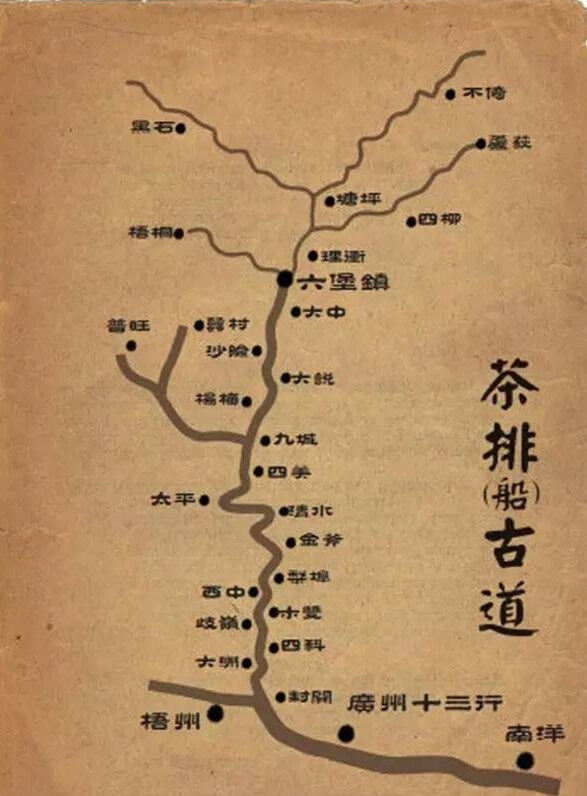
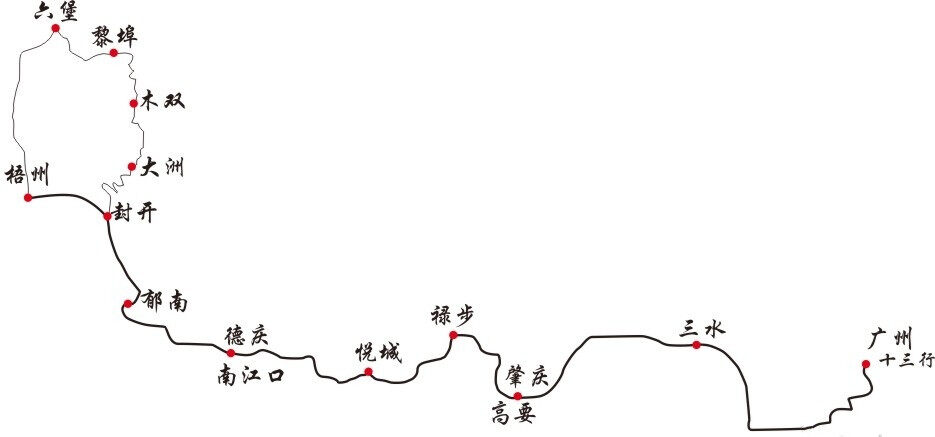
During the Ming and Qing Dynasties, with the rise of the tea trade, the ancient tea boat road with the Hejiang and Xijiang channels as the link gradually prospered. Guangxi tea merchants bought tea in Liubao Town, and then transferred them to Guangzhou in Fengkai, where they sailed to Nanyang. At the same time, Liubao Tea also went north through the Xiaohe Ancient Road and Lingqu to the court.
Ancient Tea Boat Road
Whether it is going north and south, or east and west, as an important node of the Xiaohe Ancient Road and the Tea Boat Road, Fengkai is a must.
The Xiaohe Ancient Road starts at Xiaoshui and ends at Hejiang, with a total length of 187 kilometers. In Fengkai, the Hejiang River is 115 kilometers long. In addition to the Hejiang Channel, there are also several post stations and shops on the land. In those days, caravans relayed by land and by water, camel teams were in line, carrying hands on their shoulders, one pavilion for five miles, one shop for ten miles, resting on the way, and goods trading, which became a beautiful scenery in Fengkai.
Pinggangpu is located in Pingfeng Town, Fengkai County and is one of the 14th stores in Fengkai. Pinggang Post Road leads up to Cangwu County, Wuzhou City, and connects to the capital and towns of Yunan County at the bottom. At that time, the commercial traffic was developed. There are existing historical sites such as Taixin Bridge, Pinggang Ancient Street, Pinggang Ancient Well, Pinggang Artillery Tower and Pinggang Tianhou Palace. There is still a 200-meter-long ancient post road paved with granite. Editor/He Yuting
Comment





 Praise
 Collect
 Comment

 Share
Share


Write something~