 Search


- After the completion of the Chaka branch line disease project of the Xiqingcha Railway, the transportation capacity will be improved
- After the opening of the Xige section of the Qinghai-Tibet Railway, the capacity and efficiency of the entire line will be improved
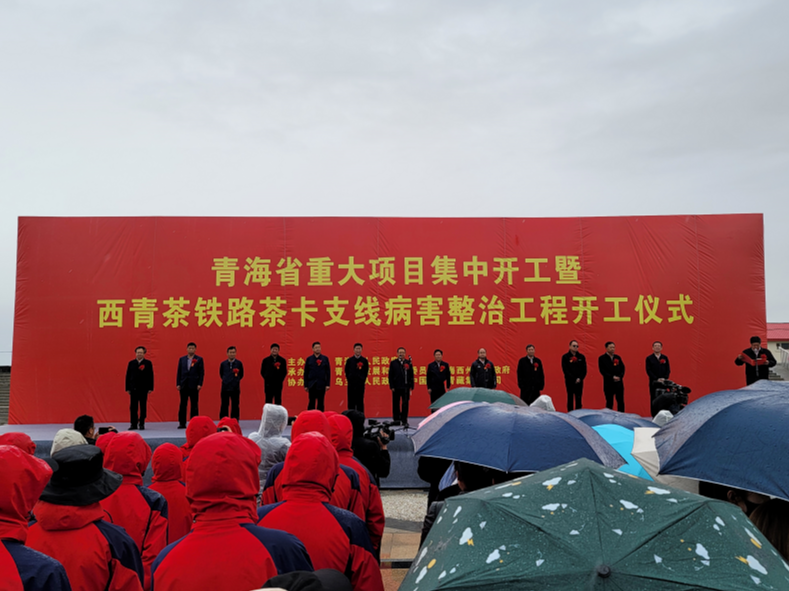
At 11:18 am on June 24, 2021, the Xining-Qinghai Lake-Chaka (Chaka (Chahanno) Railway Chaka Branch Line Disease Remediation Project, which was conducted by the No. 1 Railway Institute of Railway Survey and Design and Construction by China Railway 17th Bureau Group, was in Haixi, Qinghai Province. Construction of Chaka Town, Mongolian-Tibetan Autonomous Prefecture officially started.
The Qinghai-Tibet Plateau adds another large steel transportation channel
The new line of Xiqingcha Railway is 275.96 kilometers with a design speed of 200 kilometers per hour. It is a national railway I-level electrified single-track railway. The east end of the line is connected to the Xining hub, and it passes through Duoba New Town, Huangyuan County, and Gonghe County, Hainan Prefecture in the west. , Chaka Town, Ulan County, Haixi Prefecture, and extended the electrification of Chaka branch line to Chahannuo Station, connecting with the existing Qinghai-Tibet Railway Xige Section, forming a high-quality railway around the lake. The Xiqingcha Railway also includes disease remediation and reconstruction of the existing 35-kilometer Chaka branch line to improve the overall transportation capacity.

The use of advanced LiDAR photogrammetry technology in the survey
The Xiqingcha Railway runs through the hinterland of the Qinghai-Tibet Plateau. The geological conditions along the line are complex, and it faces many engineering geological problems such as collapsible loess, swelling rocks, landslides, and high ground stress. Since the launch of the full-line survey in February 2021, the First Railway Institute has conscientiously implemented the requirements of Qinghai Province. The on-site survey team has overcome difficulties such as plateau hypoxia, ecological fragility, tight construction period, and complex plans, and adopted airborne LiDAR aerial photography technology. Advanced technical means, through scientific and detailed on-site work, comprehensively and accurately grasp the geological conditions along the line, scientifically plan the route, station and connection plan, and earnestly implement environmental protection along the line to lay a solid technical foundation for the smooth progress of the project.
The construction of the Xiqingcha Railway can further optimize the channel configuration of the Qinghai-Tibet Railway and fill the gap in the road network in the Pan-Republican Basin. After the project is completed, it will directly connect scenic spots such as Qinghai Lake, Chaka Salt Lake, Black Horse River, Longyangxia Reservoir, Riyue Mountain, and Danger Ancient City. At the same time, high-speed trains including Xi'an, Lanzhou, Chengdu, and Chongqing will be launched during the tourist season. . By then, starting from Xining, it will be possible to reach Qinghai Lake in 1 hour and Chaka in 2 hours, which is of great significance for promoting the flow of people and materials along the route, driving the development of tourism resources, and promoting rural revitalization.

On the morning of June 24, 2021, the launching ceremony of the Qinghai-Tibet Railway Xining-Golmud Railway Section's quality improvement project designed by the First Railway Institute was held at Delingha Railway Station in Qinghai Province.
Drive the EMU to Lhasa
The Qinghai-Tibet Railway is currently the only railway link between the Qinghai-Tibet Plateau and the mainland. Among them, the first phase of the Qinghai-Tibet Railway from Xining to Golmud has a total length of 816.5 kilometers. Construction started in 1958 and delivered to operation in 1984. It is an important part of the Qinghai-Tibet Railway. The railway passes through the three ethnic autonomous prefectures of Qinghai Haixi, Hainan and Haibei.
In recent years, the rapid improvement of China's comprehensive national strength and the urgent needs of the economic and social development of Qinghai and Tibet have placed higher requirements on the transportation capacity of the Xining-Gelmud railway, and the transformation and upgrading of the entire line is imminent.

The technical team investigates the bridge and culvert diseases of the Xige Railway
According to the person in charge of the First Railway Institute, due to the early construction of the Sige Railway, due to the constraints of the construction conditions, mechanical equipment and environmental conditions at that time, the technical standards and construction level of the railway were limited. Although it has undergone many renovations and upgrades, it is still only capable of operating ordinary trains with speeds of 120-140 km/h, and some roadbeds and bridges and culverts along the line still have problems such as frost heave, sand damage, saline soil roadbed, and marsh roadbed, which are serious It restricts the overall improvement of railway transportation capacity.
The overall length of the Xige Railway Quality Improvement Project is 760 kilometers. On the one hand, the design will comprehensively treat the roadbed freezing damage, saline soil disease, sand-damaged roadbed and diseased bridges and culverts on the whole line; on the other hand, the number of passengers sent is relatively high. Intermediate stations such as Huangyuan, Haiyan, Ulan, Delingha, etc. will strengthen the passenger transportation facilities, and at the same time, carry out basic engineering such as rain sheds, platforms, depots and other related supporting facilities such as automated integrated information management systems for the entire line of EMUs. All-round upgrading and transformation will lay a solid foundation for the 160 km/h EMU on the Xige section of the Qinghai-Tibet Railway.
After the opening of the Xige section to improve the quality of the project, the travel time of Xining to Golmud EMU will be reduced to less than 5 hours, which will greatly improve the transportation capacity and efficiency of the Qinghai-Tibet Railway. Editor/He Yuting
Comment


 Praise
 Collect
 Comment

 Share
Share


Write something~